Tuesday, January 24, 2012

Before Hitler the Aryan Master Race was America’s ideal

“[T]he concept of a white, blond-haired, blue-eyed master Nordic race didn't originate with Hitler. 


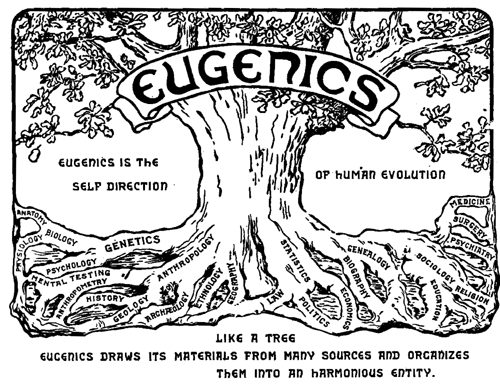
"Eugenics is the self-direction of human evolution": Logo from the Second International Eugenics Conference, 1921, depicting Eugenics as a tree which unites a variety of different fields (Wikipedia)


Introduction: While I will be drawing on multiple sources for this article, I recommend Edwin Black’s War Against the Weak to the reader interested in a single source for the topic of America’s pursuit of it’s own Aryan racial population. I will allow Mr. Black to provide the introduction:

Eugenics was the racist pseudoscience determined to wipe away all human beings deemed "unfit," preserving only those who conformed to a Nordic stereotype. Elements of the philosophy were enshrined as national policy by forced sterilization and segregation laws, as well as marriage restrictions, enacted in twenty-seven states. In 1909, California became the third state to adopt such laws [the first was Indiana, 1907]. Ultimately, eugenics practitioners coercively sterilized some 60,000 Americans, barred the marriage of thousands, forcibly segregated thousands in "colonies," and persecuted untold numbers in ways we are just learning. Before World War II, nearly half of coercive sterilizations were done in California, and even after the war, the state accounted for a third of all such surgeries.”

Eugenics was not an “invention” of the United States, but it was enthusiastically embraced by America. Politicians, educators, social scientists of all stripes saw in genetic engineering and the resulting American racial ideal a strategic national imperative, a goal of the highest order. The following are drawn from the book, The Nazi Connection, by Stefan Kuhl: In his inaugural address, Woodrow Wilson said: “[T]he whole nation has awakened to and recognizes the extraordinary importance of the science of human heredity [eugenics], as well as its application to the ennoblement of the human family… Theodore Roosevelt expressed the fear that “inferior” segments of the population were gaining power.” Steps taken to control the danger to humanity’s “ennoblement,” to ensure that the “inferior” would not “gain power”, at least in the early years included legalization of the involuntary sterilization of the “unfit,” and laws “that prohibited marriage and sexual intercourse between blacks and whites... The Commission of the American Genetic Association… proposed that the lowest 10% of the population be sterilized. [The measure] was intended to “eradicate” the “inferior” members of the society over a time period spanning two generations.”

Without American leadership, training and support, German National Socialism would likely have still pursued the Final Solution to the West’s Jewish Problem, but the effort would have lacked the credibility of a “scientific” justification, the enthusiastic moral support of America’s elite, the funds provided by America’s wealthy.

The Immigration Restriction League (founded in 1894) was the first American entity associated officially with eugenics. The League sought to bar what it considered dysgenic members of certain races from entering America and diluting what it saw as the superior American racial stock through procreation.” Although “eugenic ideas” were already “in the air” among America’s elite in the 19th century (Alexander Graham Bell, married to a deaf woman, proposed sterilization as a way to eliminate “deafness” from America’s gene pool around 1881) America’s movement to genetically engineer an ideal racial stock gained general popularity only in the early 20th century.


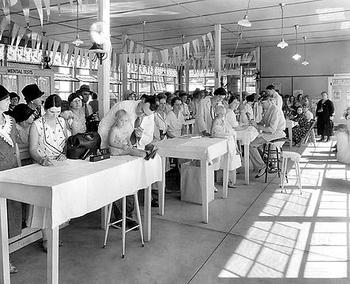
 Contestants get ready for the Better Baby Contest at the 1931 Indiana State Fair (Wikipedia)

In 1904 the Carnegie Institution created a laboratory complex on Long Island dedicated to eugenics research. Carnegie generosity was soon matched by other far-sighted philanthropies such as the Harriman railroad fortune and the Rockefeller Foundation. “The Rockefeller Foundation helped found the German eugenics program and even funded the program that Josef Mengele worked in before he went to Auschwitz.” But this is getting ahead of our story.
Before describing how American eugenics was applied as social engineering in the years before Nazism it is instructive to acknowledge some of its more prominent supporters.

A short list of the founders of the American Eugenics Society (established in 1922) includes: J. P. Morgan, Jr. of U. S. Steel; Miss E. B. Scripps of Scripps-Howard and United Press International; John H. Kellogg of cereal fame; Margaret Sanger of Planned Parenthood.

Prominent politicians and others included: President Theodore Roosevelt; President Woodrow Wilson; Alexander Graham Bell; the Rockefellers, Harrimans, and Carnegies; Supreme Court Justice Oliver Wendell Holmes, to name a few.

Nearly all educational institutions from Ivy League to local collages promoted eugenics as a positive model to improve the national gene pool. Positive change, according to the model, would be achieved through encouraging, “the higher classes of society to reproduce offspring.” Those outside that model, the “unfit,” would be eliminated “humanely” by forced sterilization. Euthanasia, or “negative eugenics,” was proposed as a national project, was in fact utilized by some physicians and hospital administrators, but never became, as in Germany, a national program of race improvement. One reason advanced was that Germany’s public and overuse of euthanasia made it unattractive outside of Europe.

The “Unfit” defined: Among the so-called genetic traits to be eliminated from the national Aryan gene pool was deafness, blindness, insanity, criminal tendencies and laziness. Schizophrenia, bi-polar disorder and depression: mental illness in general was also slated for elimination. Some races would be allowed to survive in segregated reservations, but sexual intercourse or intermarriage, called miscegenation, would be illegal and carry severe penalties. But restrictions on racial intercourse was not unique to eugenics; its history as practiced by many states went back to the American colonies.

“In 1907 Indiana became the first of more than thirty states to adopt legislation aimed at compulsory sterilization of certain individuals. Although the law was overturned by the Indiana Supreme Court in 1921, the U.S. Supreme Court upheld the constitutionality of a Virginia law allowing for the compulsory sterilization of patients of state mental institutions in 1927.”

Eventually thirty-three states would adopt laws, backed by the U.S. Supreme Court, providing for involuntary sterilization resulting in more that 60,000 by mid-century. The last legal forced sterilization in the United States was performed thirty-six years after WWII, in Oregon in 1981.

The American model of race improvement by means of sterilizing the “unfit” would be replicated by the Third Reich. “[T]he Germans enacted compulsory sterilization laws partly based on the U.S. experience, and American eugenicists took pride in their influence on Nazi policies. 

Miscegenation laws forbade sexual relations, including marriage, between white and non-whites in the United states from earliest colonial days until as recently as the year 2000. Penalties varied from state to state and could involve a fine, “up to $2,000 and/or prison terms of up to 10 years.” But often offenders did not face justice in court, but at the end of a rope, or worse.

At mid-20th century approximately 30 states still had laws regarding miscegenation. One example was the Virginia Integrity Act of 1924. It prohibited marriage between a white person and anyone with a trace of blood other than Caucasian. The 1967 Supreme Court decision on Loving v. Virginia made American anti-miscegenation laws unconstitutional.” At the time of the Court’s decision Barack Obama was six years old.

But Virginia was not the last state to surrender its miscegenation laws. Alabama was the last hold-out and only rescinded the law in November, 2000.


Recent writings in this Series:

Wednesday, January 4, 2012

Zionism , from antisemitism to Holocaust


“Eliminate the diaspora or the diaspora will eliminate you!”
 (Ze’ev Jabotinsky, Poland, 1937)

Had antisemitism remained social and political very likely most Jews, conditioned by centuries of religion-inspired discrimination, would have patiently waited for the most recent storm to pass. But following 1500 years of persecution and the dawn of political-religious reform, having tasted the promise of emancipation and acceptance represented by the Enlightenment, for some at least hope turned quickly to despair. Awareness grew that Christendom’s religion-based Jewish Problem was too deeply embedded in the in the West’s history and culture to vanish because secularism replaced religion-based society.

Jewish responses to Emancipation and continuing discrimination predated Zionism by decades. Two very different such efforts, are represented by Moses Mendelssohn, descended from a line of orthodox rabbis, and Karl Marx, the son of a Lutheran convert himself the son of a rabbinical family. Mendelssohn would ensure Jewish survival by “modernizing” religious practice while Marx’s was far more radical: Jewish identity along with Judaism would fall away, as would distinctions for all based on class, religion and nationality in proletarian revolution (pardon the obvious oversimplification). He wrote On the Jewish Question in 1843 in part in opposition to an opponent of Jewish emancipation. But the work was also a first attempt at his theory of dialectical materialism, and in it he identified the Jews symbolically with money, the West’s universally recognized stereotype. This symbolic representation of the Jews would provide a rationale for already existing antisemitism, provided a political ploy for both the left and the right, before and after the Holocaust and, when a state of the Jews appeared, included Israel and the movement whose creation it was, Zionism.

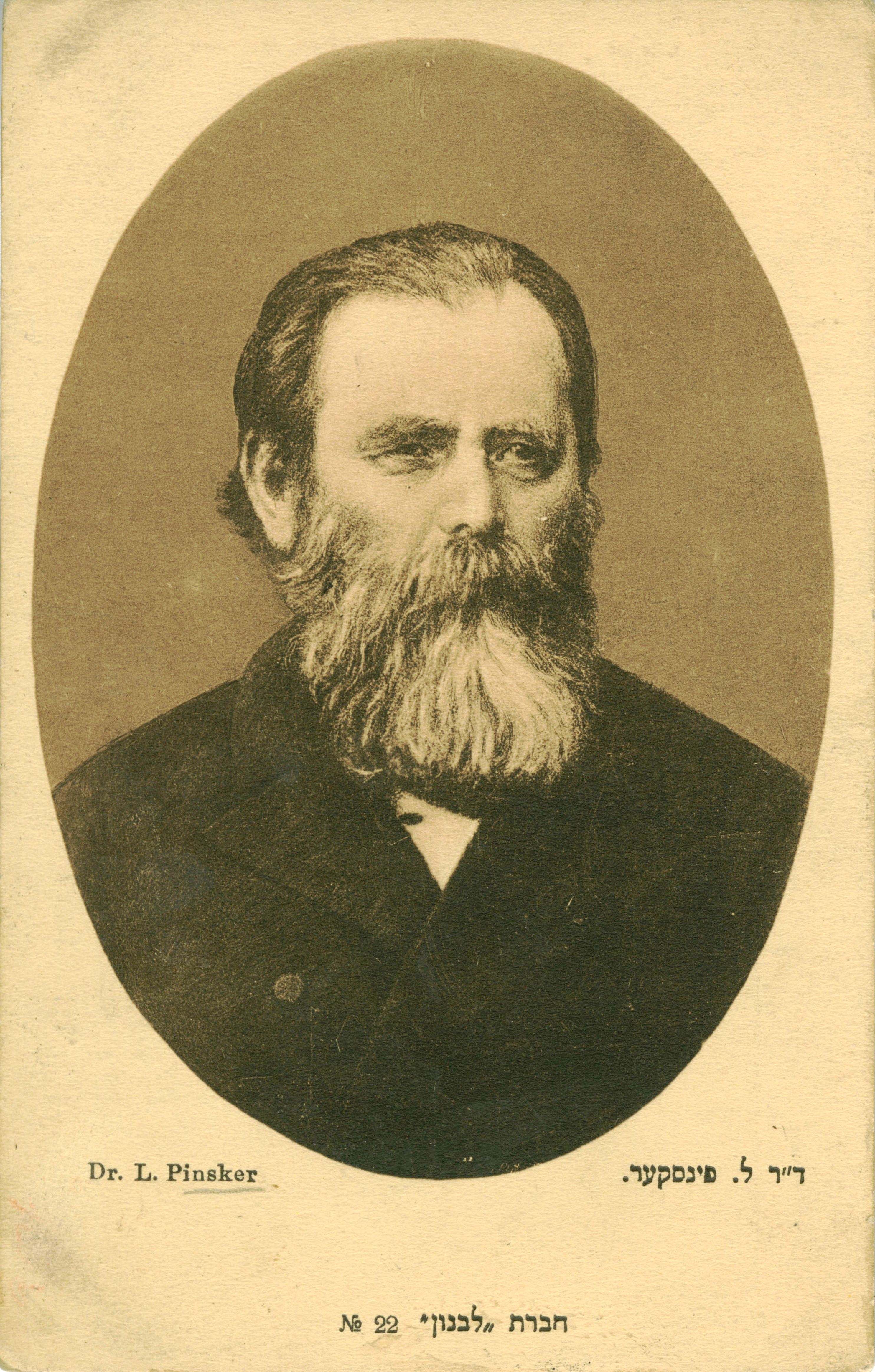
The first sparks of what would become a Zionist movement came out of Russia-Poland in the late nineteenth century. In 1882 Leon Pinsker, an assimilated Russian physician wrote Autoemancipation, a prescient work that anticipated the risk to Jewry in the twentieth century. That work, written fifty years before Germany voted the National Socialists into power, may even today represent the most accurate diagnosis of the condition of Jews in Christendom; of the West’s Jewish problem and its cure

Leon Pinsker (Wikipedia)

Pinsker’s preface is an impassioned Zionist challenge: Take responsibility for the fact that antisemitism is a permanent feature of the Western Diaspora; accept that the obvious Jewish response to “the terror of bloody atrocities” is self-emancipation, the creation of a Jewish national homeland.

After the terror of the bloody atrocities [the pogroms] a moment of calm… the Western Jews have again learned to suffer the cry, "hep! hep!" [by anti-Jewish rioters, typically students, in Germany]… Shut your eyes and hide your head like an ostrich -- there is to be no lasting peace unless … you apply a remedy more thoroughgoing than those palliatives to which our hapless people have been turning for 2000 years.”

“But,” Pinsker continues, “the greatest impediment in the path of the Jews to an independent national existence is that [we] do not feel its need… deny its authenticity (see Jabotinsky, below).”

Pinsker was not a Marxist but a Zionist and his solution to the Jewish problem lay not in a larger social revolution but in the removal of the Jews from that danger: “This change cannot be brought about by the civil emancipation of the Jews in this or that state, but only by… the foundation of … our inalienable home, our country.” Pinsker the physician diagnosed Judeophobia a, “psychic aberration… [an incurable] disease transmitted for two thousand years… Prejudice or instinctive ill-will is not moved by rational argument (so much for educating society away from persecution), however forceful and clear.”

For several decades after the appearance of Autoemancipation young and idealistic Jews, inspired by Pinsker and prodded by pogrom, made their way to Palestine as individuals and in groups. Among the first were the Hoveivei Zion, the Lovers of Zion, who founded Rishon l’Zion, one of the first Jewish towns in Palestine. But enthusiasm alone was not enough to inspire immigration sufficient to create in a state, and another decade would pass before another, more charismatic and politically-savvy leader would appear.

Theodor Herzl in Basel, 1897 (Wikipedia)

Theodore Herzl, another assimilated Jew, was a Viennese playwright and journalist. In 1894 he was sent to Paris to cover the treason trial of Captain Alfred Dreyfus. “Herzl witnessed mobs shouting “Death to the Jews” in France, the home of the French Revolution, and resolved that there was only one solution: the mass immigration of Jews to a land that they could call their own.” Apparently unaware of Pinsker or Autoemancipation, Herzl came to the same conclusion regarding the risk to Jewish survival in the West. Antisemitism, he concluded, “was a stable and immutable factor in human [well, Western] society, which assimilation did not solve.”

Recall that the events described above took place before the First World War, before National Socialism was voted into power in Germany and half a century before the West embarked on its final solution to it’s Jewish problem. For the Jews, at least, the Holocaust was still unimaginable. But some among the younger generation were already sensing the coming, if indefinable, disaster. Among them was Ze’ev Jabotinsky.

Following Hitler’s electoral victory Jabotinsky crisscrossed Poland and Eastern Europe warning of the impending Final Solution. While few took the warning seriously, who beyond visionaries could imagine the unimanageable and unprecedented fate awaiting the Jews, Jabotinsky knew. On Tisha B’ Av of 1937, a traditional day of mourning on the Jewish calendar a leader accepting defeat Jabotinsky exhorted the Jewish people to expunge themselves of the Diaspora or perish:

It is already three years that I am calling upon you, Polish Jewry… warn you incessantly that a catastrophe is coming closer… [you] do not see the volcano which will soon begin to spit all-consuming lava… In the name of G-d! Let anyone of you save himself, as long as there is time, and there is very little… whoever of you will escape from the catastrophe, he of she will live to see the… the rise of a Jewish state.

“Eliminate the Diaspora or the Diaspora will eliminate you!”


Recent writings in this Series:

An American lynching: the Leo Max Frank Affair


Ninety years ago, some of Marietta's leading citizens gathered to hang a man, Leo Frank, a Jewish superintendent of an Atlanta pencil factory… [He was] murdered on a farm belonging to former Cobb County sheriff William Frey.”

Introduction: The trial and murder of Leo Frank stands in stark contrast to the outcomes of those other contemporaneous antisemitic outrages, the “trials” of Menahem Beilis and Alfred Dreyfus. In the end Russia and France, however reluctantly, recanted and their victims survived. Not so the American Jew. This incident illustrates the depth of antisemitism present in the United States for decades preceding the First World War, a level that only intensified after that war, and continued to do so through the Second World War and beyond. It was this same antipathy towards Jews, endemic to Western culture, that resulted in America violating its long tradition of refuge as last resort, at least when it came to Europe’s Jews fleeing the Holocaust.

Leo Max Frank was manager of the National Pencil Factory in Atlanta, Georgia. On the night of 27 April, 1913 the body of a thirteen year old employee was discovered in the factory basement. She had been raped and strangled.

Frank was accused of the 1913 murder of Mary Phagan, a former Mariettan who worked at the National Pencil Factory in Atlanta. Historians [and some police investigators at the time] believe that the state's main witness, Jim Conley, a janitor at the factory, murdered the 13-year-old girl.”

As it turned out John Conley, “who was arrested when he was seen washing red [described as “blood”] stains from a shirt,” became the state’s main witness. Conley, who had an arrest record involving alcohol and violence, “later gave at least four contradictory affidavits explaining how he had helped Frank dispose of the body. ”At one point he testified to being illiterate, a claim later contradicted when he asserted that Leo Frank had ordered him to write two notes, as if by the girl, as she lay dying. Conley also claimed that Frank paid him $200 for helping move the body but, but when asked by the police where the money was he claimed Frank had taken it back.

One of the two murder notes found near the body. (Wikipedia)

Tom Watson, publisher of the Jeffersonian newspaper, [see earlier submission] was instrumental in creating the atmosphere of antisemitism that would shape public outrage against Frank. He made cash payment to the police for access to police evidence, was accused of having removed evidence he felt favored Frank.

The grand jury investigating the case indicted Frank in the death of Mary Phagan on 24 May, 1913. On 28 May the pencil factory foreman was reported by the newspaper The Georgian to have said that he believed Conley "strangled Mary Phagan while about half drunk.” Two other witnesses against Conley were also not called to testify.

Why the grand jury chose not to pursue Conley, is not known. What is known is that following the indictment several members of the panel expressed doubts regarding Frank’s guilt, felt Conley should have been the one indicted.

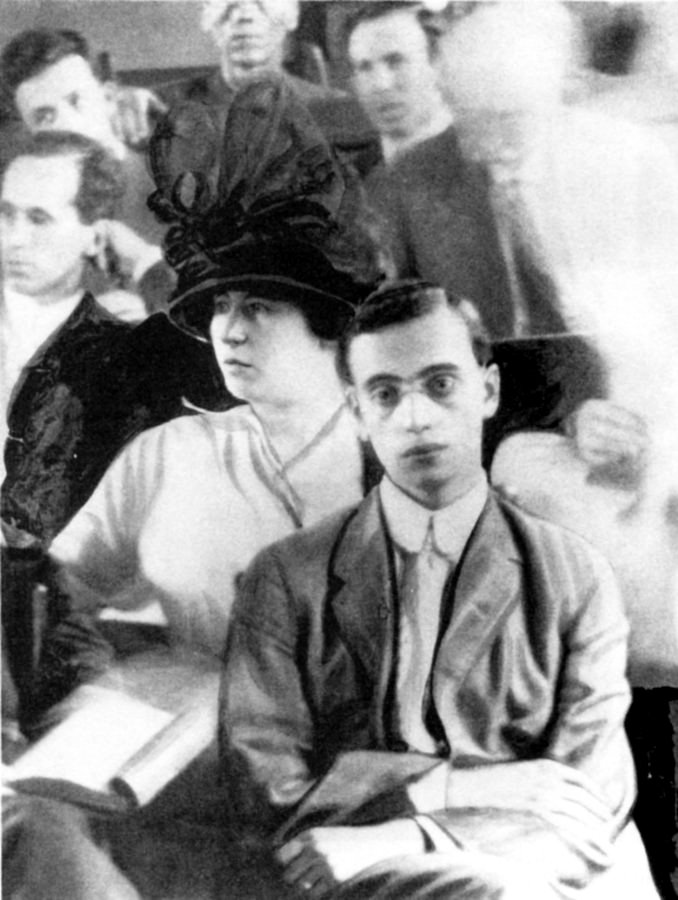
Lucille and Leo Frank at Frank's trial. (Wikipedia)

Amidst controversy surrounding the police investigation, the manipulation and even disappearance of evidence; with accusations of witness badgering and even coaching by the police and prosecution, the trial ended on 26 August, 1913. Frank was convicted in the murder. Presenting evidence of jury tampering and intimidation a mistrial was demanded. And denied. Frank’s conviction was greeted with jubilation in the street.

William Manning Smith, the attorney who initially defended Conley, reversed his position in 1914 after concluding that his own client was the guilty party.”

Appeals to both the Georgia and US Supreme Courts were unsuccessful.

Tom Watson, who in 1920 would represent Georgia in the US Senate, had little patience for the “legal wrangling” following Frank’s conviction. “If Frank's rich connections [a not subtle reference to the Jews] keep on lying about this case,SOMETHING BAD WILL HAPPEN!” But out of public view, “Watson let it be known to [Governor] Slaton that he would throw his support behind a Senate bid if only the governor would let Frank hang.”

Days before leaving office the governor, citing inconsistencies in evidence, commuted Frank's sentence to life in prison. Forty years later the governor would recall that he was convinced following the trial of Frank’s innocence and assumed “[it] would eventually be fully established and he would be set free”.

Responding to the governor’s decision Watson led a group of Georgia’s finest citizens to the prison, drove Frank 240 miles to , “A site at Frey's Gin, two miles east of Marietta [Mary Phagan’s home], had been prepared, complete with a rope and table supplied by former Sheriff William Frey. The following morning the self-styled “Knights of Mary Phagan” lynched Leo Frank

The lynching of Leo Frank. The man on the far right in the straw hat is Newton A. Morris, a superior court judge. (Wikipedia)

The lynch party was not a drunken polyglot of street hooligans in a rage. Frank’s murders consisted of 26 cool and calculating members of the professions, the cream of Atlanta’s elite. Among these luminaries were: former governor Joseph Mackey Brown; Superior Court Judge Newton Morris (standing near the hanging body of Leo Frank, above); Eugene Herbert Clay, son of U.S. senator Alexander S. Clay, and himself the former mayor of Marietta; John Tucker Dorsey, a lawyer and state legislator (and solicitor general for the Blue Ridge Circuit who would have been responsible for prosecuting the lynchers, had any been indicted!).

Following the lynching a festive atmosphere prevailed, and crowds searched the site for souvenirs… A short time after the lynching of Leo Frank, thirty-three members of the group that called itself the Knights of Mary Phagan gathered on a mountaintop near Atlanta and formed the new Ku Klux Klan of Georgia.”


“On March 11, 1986, the Georgia State Board of Pardons and Paroles granted Frank a pardon, citing the state's failure to protect him or prosecute his killers. But neither did they exonerate him:

Without attempting to address the question of guilt or innocence, and in recognition of the State's failure to protect the person of Leo M. Frank and thereby preserve his opportunity for continued legal appeal of his conviction, and in recognition of the State's failure to bring his killers to justice, and as an effort to heal old wounds, theState Board of Pardons and Paroles, in compliance with its Constitutional and statutory authority, hereby grants to Leo M. Frank a Pardon.

Georgia has yet to admit to Frank’s wrongful conviction, responsibility for its miscarriage of justice.

The names of Frank's murderers were well-known locally but were not made public until January 7, 2000, when Stephen Goldfarb, an Atlanta librarian and former history professor, published a list on his website. The Washington Post writes that it includes several prominent citizens—a former governor, the son of a senator, a Methodist minister, a state legislator, and a former state Superior Court judge—their names matching those on Marietta's street signs, office buildings, shopping centers, and law offices today.”


Recent writings in this Series:

Wednesday, December 14, 2011

Political antisemitism in the United States, 1873-1932

You know this is a Protestant country, and the Catholics and Jews are here under sufferance."

Introduction: Over the past months I have described the development of anti-Judaism in Christian theology and its transformation into secular antisemitism with the 18th century Enlightenment. In the 19th century secular antisemitism quickly evolved into a political movement with an agenda aimed at excluding Jews from civil society and antisemitic parties appeared throughout the West. In Germany-Austria the political agenda changed from social exclusion to physical extermination with the goal of achieving a final solution to the West’s Jewish Problem. This week we turn to the evolution of political antisemitism in the country with the largest surviving post-Holocaust Jewish Diaspora population, the United States.

As in Europe, organized political antisemitism also appeared in the United States in the 19th century. And, as in Europe, a movement to deny Jews legal and social rights did not just appear: it emerged from an already present antisemitic culture.


The first Jews to set foot in the New World arrived with Christopher Columbus in 1492. In 1584 Joachim Gaunse, a Jewish metallurgist who accompanied Sir Walter Raleigh to the Virginia territory, was threatened with blasphemy and forced to return to England. “In 1647, the Portuguese authorities arrested Isaac de Castro for teaching Jewish rites and customs in Portuguese controlled Brazil and sent him back to Portugal where the Inquisition sentenced him to death and burned him at the stake.” Seven years later twenty-three Jewish refugees fled Portuguese Brazil for the more tolerant Dutch New Amsterdam (later renamed New York under the British) where they were barred entry by the colony’s Director General, Peter Stuyvesant. “The Jews who have arrived,” he wrote the directors of the Dutch West India Company, “would nearly all like to remain here, but learning that they (with their customary usury and deceitful trading with Christians)… [we ask that] that the deceitful race -- such hateful enemies and blasphemers of the name of Christ -- be not allowed to further infect and trouble this new colony…” The Company apparently felt the Jew’s “customary usury and deceitful trading” would be of value and ordered Stuyvesant to let them stay. As for French colonial areas, the Jews were barred until 1759; and the Spanish, like the Portuguese, planted the Inquisition in the New World and persecuted and executed their “suspect” Conversos, Catholics of Jewish descent.

While the 1789 US Constitution, following Enlightenment principles, protected citizen rights regardless of religion, the first acts of “political” antisemitism came in the form of “states rights,” which allowed states to make local laws, including a state’s relations with Jews. Anti-Jewish legislation would only be rescinded in North Carolina in 1869, while New Hampshire finally relented and allowed “non-Protestants” to hold state office in 1887. Sabbath laws, forbidding commerce on Sunday, was another form of legal antisemitism.  Such discriminatory laws remained on the books well into the twentieth century. Their antisemitic intent was clearly described when, “in the 1855 California assembly debate on the topic, the speaker of the house argued that Jews ‘ought to respect the laws and opinions of the majority.’”

As for “popular antisemitism,” attitudes held by individuals: “when a Jew rose to national prominence, he would always be open to attacks based upon his Judaism.” Mordecai Noah, a diplomat to Tunis from 1813-15, was recalled from his post having been denounced as an “enemy of Christ.” And, “Uriah Phillips Levy, then the only Jewish officer in the U. S. Navy, was dropped from the officer list in 1855… after six courts martial, two dismissals, and the killing of one opponent in a duel, all over slurs against his Judaism.”

Political antisemitism: Social stress is generally associated with a rise in antisemitism. This was also true during the Long Depression of 1873 to 1896. The period gave rise to the emergence of populist political parties, most of which were short-lived. With the appearance of the Populist, or Peoples Party, things changed and antisemitism entered American party politics.

During the presidential election of 1896 no “political party was above using anti-Semitism, especially to appeal to Christian constituents, but it was the Populist Party who used anti-Semitism most distinctively.

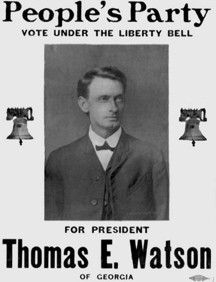
Watson on a 1904 People's Party campaign poster. (Wikipedia)

Tom Watson, who will reappear when we discuss the lynching of Leo Frank, was named vice presidential choice on the 1896 Populist Party presidential ticket and, in 1904, the party’s choice for president. The "Populists strengthened their cause by using religious metaphors to link money with a Jewish conspiracy [giving license to mainline parties to do the same]. Thus in 1896 Democratic presidential candidate William Jennings Bryan, speaking in an idiom Protestant Fundamentalists were fully conversant with, could easily intersperse biblical imagery with economic necessity when he thundered, `You shall not press down upon the brow of labor this crown of thorns, you shall not crucify mankind upon a cross of gold.' The antisemitism evoked by the metaphor of the crucifixion was powerful and appealed to rural Protestants who possessed a similar religious and cultural heritage with other Americans in the South and the West," (Leonard Dinnerstein, Antisemitism in America, p.49-50). But when standing before a Jewish audience Bryan temporized, "We are not attacking a race, we are attacking greed and avarice, which know neither race nor religion. I do not know of any class of our people who, by reason of their history, can better sympathize with the struggling masses in this campaign than can the Hebrew race," from The First Battle, (p.581).

By the twentieth century racist antisemitism was even more open and popular, appearing in vaudeville, on the stage and even in the movies. In 1913, amidst a heated antisemitic atmosphere, an innocent Leo Frank was convicted of murder and, when the governor commuted his sentence, was dragged from his cell and lynched. One result of the lynching was the decision by B’nai Brith, of which Frank was regional director, to form the Anti-defamation League. Another was the re-emergence of the Ku Klux Klan. By the 1920’s Henry Ford was distributing his Dearborn Independent by mail and in Ford Motor dealerships across the country. Its main contribution to the spread of antisemitism was publication, under the banner of the International Jew, the Protocols of the Elders of Zion. American antisemitism was equal to that taking hold in Europe, with Jews discriminated against in housing, employment and recreation.

A 1934 edition by the Patriotic Publishing Company of Chicago (Wikipedia)

Parties specifically targeting Jews proliferated in the years leading up to the Second World War. “The era gave rise to domestic anti-Jewish bigots, such as Father Charles Coughlin, Gerald L. K. Smith and William Dudley Pelley, the leader of the Silver Shirts. It also witnessed the rise of the German-American Bund, led by Fritz Kuhn, and the notorious anti-Jewish speech by the aviator and US hero Charles A. Lindbergh to an America First Committee rally. Especially influential in the 1930s was Father Coughlin, a Catholic priest whose weekly radio broadcasts containing an openly antisemitic message reached millions. Coughlin's campaign paved the way for isolationist organizations, such as the America First Committee, to attract antisemites to their banners.”


Other writings in this Series:

Tuesday, December 6, 2011

Is the Diaspora Doomed, Israel abandoned? An open Response to an email responder

Thank you for your email, Larry. I well remember our earlier discussion and, it appears, neither of us has much shifted in the interim! While I accept your position regarding the history of antisemitism reflected in Church/Christian policy; while I continue to accept also your distinction between us and them regarding slavery: still, beyond educating our youth to the reason we are hated, I don’t see the Zionist mission of providing for our physical salvation being advanced. My concern as I hope is reflected in all my writings is to demonstrate to the best of my abilities to my admittedly tiny audience the danger to our physical survival represented by Christendom (religion and secular); in other words, to our Diaspora.


Although not identical the threat to the state of the Jews is similar, as reflected in Bush and Iraq and, more blatantly, under the present administration. I am entirely non-(American) partisan in my comments, simply reflecting the facts as objectively as I can interpret them.

I am not so quixotic as to expect our Diaspora to rise up and leave; where to? The only other Jewish “homeland” was created under Stalin, the Jewish Autonomous Oblast in Siberia. And I hardly expect that to be open to mass Jewish immigration today even if we would all choose to move! Neither do I expect Israel to immediately abandon her quixotic “special relationship” with the US; after all, we are still tiny and vulnerable and dependent on the US, whatever the cost. What I am hoping to achieve is to raise doubt in the denial-prone consciousnesses of both communities as to the need to respond realistically to a very real environment. For me the enemy is not our lack of knowledge of the past, but our failure to accept its meaning for the future.

For our Diaspora “Never Again!” is an inappropriate and inadequate response to the Holocaust. The Shoah is a clear shot across our bow, the promise of things to come unless we take its implications seriously, and act. And for Israel, while our dependence on the West is real, it is long past time to begin looking outside Christendom for our next strategic alliance. China has few Christians and no culture or history of antisemitism; India, with its Moslem population, would still represent a problem so long as the state of the Jews remains in theMiddle EastIsrael simply must grow beyond her neediness, our emotional dependence on a false special relationship that in reality is special for the US, and that only so long as Israel fulfills America’s interests. And under the present US administration that bottom-line should, by now, be crystal clear.

Obama’s mouthpiece Panetta said as much, Israel, too, has a responsibility to pursue these shared goals – to build regional support for Israeli andUnited States’ security objectives.” For the US the bottom line is the US. That was how it was in 1940 when the US chose to ignore its “special relationship” with Britain under attack from Germany. If Britain is expendable, where does our faith come to play?

While I understand and substantially agree with your position, Larry, short of Divine Intervention (which failed to materialize in the Roman war) I fail to see how it will affect our physical survival in the real world, comes the real Final Solution to the West’s Jewish Problem?

Sounds harsh. But I know no other way to say that which I consider obvious.

Regards,
David

Monday, December 5, 2011

America's Deconstruction of the Middle East: from Bush’s Iraq to Obama’s Egypt


Neither Israel, nor any of the mainstream Arab governments accept the Obama-Panetta proposition that time will magically temper the extremism of the Islamist regimes.”

Whenever US Middle East policy fails the administration in power turns on Israel as ready scapegoat. This occurred in the 1980’s when Irangate, the Reagan administration criminal involvement in drug trafficking, gun-running and money laundering began appearing in the press. And if the president eventually apologized to the Jewish state, in the end his administration deftly redirected attention away from their criminality to Israel and her spy Jonathan Pollard. And when Bush’s confident victory proclamation proved premature administration insiders sought to shift blame for the war onto Israel (actually Israel, Egypt and the Saudis strongly advised againstthe war!).

Enter my vote for America’s alternative to dirty and confused politics, Barak Obama. In style and apparent philosophy Obama appeared and may well be the opposite of his predecessor. But if the recent resignations of his two key Middle East advisers George Mitchell and Dennis Ross are an indication such qualities can also produce ideological rigidity, an inability to recognize and respond to situations that may not fit preconceptions. And that certainly seems to explain President Obama’s inability to grasp the complexities of the Middle East over the past two-plus years in office. And Obama, like earlier administrations: when failure looms, blame Israel.

Although Obama cannot be personally blamed for the regional disaster represented by the invasion and withdrawal from Iraq (Bush decisions set both in motion) Obama has followed Bush in shying away from directly confronting the consequences of the invasion. Having deposed the Sunni Baath regime and replaced it with one headed by Iraq’s Shiites Bush redefined the balance of power in the region from the Arabs to the Persians. Shiite Iraq was transformed from bitter enemy to potential ally and satellite of Iran


Saddam Hussein being pulled from his hideaway in Operation Red Dawn, 13 December 2003, (Wikipedia).

Bush replaced Donald Rumsfeld with Robert Gates as secretary of defense. An outspoken opponent of even the threat of force against Iran, if Bush wanted to avoid confronting Iran he could have chosen no better replacement. When Obama succeeded Bush he retained Gates at defense, a clear statement of his own intentions regarding the Islamic Republic. And when Gates retired Obama replaced him with his apparent clone, Leon Panetta. Both defense secretaries and their chairmen of the US Joint Chiefs strongly supported the Bush/Obama policy of Appeasement (what better descriptive of Obama’s carrot-stick-retreat approach to Iran’s nuclear weapons program?). Obama became Ahmadinejad’s unwitting “straight-man,” something of a joke on the Arab street, and the US was losing face and credibility at an accelerating pace with regional friend and foe alike.

While Obama inherited the chronic failure of an elusive and unlikely Arab-Israel peace from a long line of predecessors; while he inherited Iraq and even the policy of Iranian Appeasement from George W. Bush, when it comes to Egypt and Libya and the much Obama-vaunted “Arab Spring” it takes little special insight or knowledge to appreciate that these are Obama’s contribution to an ongoing American retreat not only from Iraq, but as regional hegemon and protector of Middle Eastern oil.

Obama’s commitment to peace between Israel and the Palestinians was laudable, but even here his rigid “idealism” resulted only in an even deeper chasm between the sides. Obama’s idealistic commitment to regional “democracy” is again worth as an ideal, but as policy a disaster. His decision to back the Tahrir Square demonstrators and force Mubarak from office is, as a regional misstep, on par with Bush’s invasion of Iraq in terms of impact on America’s credibility in the region. And when, days before Egyptian elections and the expected landslide victory of Egypt’s Islamists Obama told the military the time arrived to turn over governance to “civilian rule.”

Mubarak on trial, (Reuters).

Iran has always represented the primary threat to America’s regional interests. The Iranian threat also represents a rare common concern uniting Israel and the Arab states. Following Obama’s actions in deposing Mubarak the Saudis were so incensed as to refuse even to take Obama’s phone calls. The refused even to allow visits from high level US diplomats. So mistrustful of their previous protector they entered into a secret agreement to purchase and house nuclear weapons in Pakistan, announced their intention to build their own atom bomb. None of these outcomes would have resulted had US policy makers been objective in viewing events on the ground, of setting ideology aside as determinant of America’s foreign policy objectives.

Three days ago, and for the second time in just over a week, Obama’s military spokesman Panetta, disowning the devastation of a US policy gone wild and following a well-established precedent laid responsibility for American failure on its always available patsy, Israel.

“Unfortunately,” said Panetta, “over the past year, we’ve seen Israel’s isolation from its traditional security partners in the region grow, and the pursuit of a comprehensive Middle East peace has effectively been put on hold.” The “traditional partners” referred to are Turkey and Egypt, but Turkey’s regional realignment was itself a much earlier result of US weakness regarding Iran, and began long before the provocation of Mavi Marmara. And as for Egypt, the current state of relations between the two countries is again the direct outcome of misguided US policy, in this instance Obama’s decision to promote Egyptian Islamists over America’s reliable and long-time ally, President Mubarak. US policy towards Libya, Yemen, Bahrain…, all consistent with an ideology of Democracy. In an ironic twist of “the War against Islamist Terrorism” America now promotes Islamist rule from the Maghreb to the Arabian Peninsula. In fact American aid to the Islamists has a long history, the Mujahedeen of Afghanistan, including Osama bin Laden, and the 1979 Khomeini revolution in Iran.

Neither Israel, nor any of the mainstream Arab governments accept the Obama-Panetta proposition that time will magically temper the extremism of the Islamist regimes [those beneficiaries of America’s dedication to “democracy”] They have before them the example of a former Democratic president, Jimmy Carter, who made the same argument 32 years ago for the West to dump the shah and welcome Khomeini's ayatollah regime.”

Had America, starting with Bush in 2003, dedicated a fraction of its military expenditure on wars in Iraq and Libya on America’s principal adversary, Russia-sponsored Iran, had Bush taken seriously the  combined advice of Egypt, Jordan, Israel and the Saudis regarding Iran the region might be less “democratic today. But hundreds of thousands of Arabs who died in those adventures would be alive today; tens of thousands of US servicemen would not have lost life or limb lives in a failed Iraqi vanity conflict; more than a trillion dollars (the actual cost of borrowed money needed to fund the Iraq war) would not today be hanging over the US economy as debt and interest. And certainly the price of oil would be a fraction of its present cost, and if the global recession were not averted at least it would have been minimized. But most importantly for the future of the region and a West threatened by Islamist terrorism, had the US taken on Iran before the costs of such an operation spiraled out of control the threat of a nuclear arms race in one of the most volatile places on the planet would have been averted.

And Israel today would not find herself threatened both by America-created instability in Arab states near and far, and by her policy-challenged senior partner in their “special relationship,” the true creator of Israel’s isolation.