Showing posts with label Mubarak. Show all posts

Monday, December 5, 2011

America's Deconstruction of the Middle East: from Bush’s Iraq to Obama’s Egypt


Neither Israel, nor any of the mainstream Arab governments accept the Obama-Panetta proposition that time will magically temper the extremism of the Islamist regimes.”

Whenever US Middle East policy fails the administration in power turns on Israel as ready scapegoat. This occurred in the 1980’s when Irangate, the Reagan administration criminal involvement in drug trafficking, gun-running and money laundering began appearing in the press. And if the president eventually apologized to the Jewish state, in the end his administration deftly redirected attention away from their criminality to Israel and her spy Jonathan Pollard. And when Bush’s confident victory proclamation proved premature administration insiders sought to shift blame for the war onto Israel (actually Israel, Egypt and the Saudis strongly advised againstthe war!).

Enter my vote for America’s alternative to dirty and confused politics, Barak Obama. In style and apparent philosophy Obama appeared and may well be the opposite of his predecessor. But if the recent resignations of his two key Middle East advisers George Mitchell and Dennis Ross are an indication such qualities can also produce ideological rigidity, an inability to recognize and respond to situations that may not fit preconceptions. And that certainly seems to explain President Obama’s inability to grasp the complexities of the Middle East over the past two-plus years in office. And Obama, like earlier administrations: when failure looms, blame Israel.

Although Obama cannot be personally blamed for the regional disaster represented by the invasion and withdrawal from Iraq (Bush decisions set both in motion) Obama has followed Bush in shying away from directly confronting the consequences of the invasion. Having deposed the Sunni Baath regime and replaced it with one headed by Iraq’s Shiites Bush redefined the balance of power in the region from the Arabs to the Persians. Shiite Iraq was transformed from bitter enemy to potential ally and satellite of Iran


Saddam Hussein being pulled from his hideaway in Operation Red Dawn, 13 December 2003, (Wikipedia).

Bush replaced Donald Rumsfeld with Robert Gates as secretary of defense. An outspoken opponent of even the threat of force against Iran, if Bush wanted to avoid confronting Iran he could have chosen no better replacement. When Obama succeeded Bush he retained Gates at defense, a clear statement of his own intentions regarding the Islamic Republic. And when Gates retired Obama replaced him with his apparent clone, Leon Panetta. Both defense secretaries and their chairmen of the US Joint Chiefs strongly supported the Bush/Obama policy of Appeasement (what better descriptive of Obama’s carrot-stick-retreat approach to Iran’s nuclear weapons program?). Obama became Ahmadinejad’s unwitting “straight-man,” something of a joke on the Arab street, and the US was losing face and credibility at an accelerating pace with regional friend and foe alike.

While Obama inherited the chronic failure of an elusive and unlikely Arab-Israel peace from a long line of predecessors; while he inherited Iraq and even the policy of Iranian Appeasement from George W. Bush, when it comes to Egypt and Libya and the much Obama-vaunted “Arab Spring” it takes little special insight or knowledge to appreciate that these are Obama’s contribution to an ongoing American retreat not only from Iraq, but as regional hegemon and protector of Middle Eastern oil.

Obama’s commitment to peace between Israel and the Palestinians was laudable, but even here his rigid “idealism” resulted only in an even deeper chasm between the sides. Obama’s idealistic commitment to regional “democracy” is again worth as an ideal, but as policy a disaster. His decision to back the Tahrir Square demonstrators and force Mubarak from office is, as a regional misstep, on par with Bush’s invasion of Iraq in terms of impact on America’s credibility in the region. And when, days before Egyptian elections and the expected landslide victory of Egypt’s Islamists Obama told the military the time arrived to turn over governance to “civilian rule.”

Mubarak on trial, (Reuters).

Iran has always represented the primary threat to America’s regional interests. The Iranian threat also represents a rare common concern uniting Israel and the Arab states. Following Obama’s actions in deposing Mubarak the Saudis were so incensed as to refuse even to take Obama’s phone calls. The refused even to allow visits from high level US diplomats. So mistrustful of their previous protector they entered into a secret agreement to purchase and house nuclear weapons in Pakistan, announced their intention to build their own atom bomb. None of these outcomes would have resulted had US policy makers been objective in viewing events on the ground, of setting ideology aside as determinant of America’s foreign policy objectives.

Three days ago, and for the second time in just over a week, Obama’s military spokesman Panetta, disowning the devastation of a US policy gone wild and following a well-established precedent laid responsibility for American failure on its always available patsy, Israel.

“Unfortunately,” said Panetta, “over the past year, we’ve seen Israel’s isolation from its traditional security partners in the region grow, and the pursuit of a comprehensive Middle East peace has effectively been put on hold.” The “traditional partners” referred to are Turkey and Egypt, but Turkey’s regional realignment was itself a much earlier result of US weakness regarding Iran, and began long before the provocation of Mavi Marmara. And as for Egypt, the current state of relations between the two countries is again the direct outcome of misguided US policy, in this instance Obama’s decision to promote Egyptian Islamists over America’s reliable and long-time ally, President Mubarak. US policy towards Libya, Yemen, Bahrain…, all consistent with an ideology of Democracy. In an ironic twist of “the War against Islamist Terrorism” America now promotes Islamist rule from the Maghreb to the Arabian Peninsula. In fact American aid to the Islamists has a long history, the Mujahedeen of Afghanistan, including Osama bin Laden, and the 1979 Khomeini revolution in Iran.

Neither Israel, nor any of the mainstream Arab governments accept the Obama-Panetta proposition that time will magically temper the extremism of the Islamist regimes [those beneficiaries of America’s dedication to “democracy”] They have before them the example of a former Democratic president, Jimmy Carter, who made the same argument 32 years ago for the West to dump the shah and welcome Khomeini's ayatollah regime.”

Had America, starting with Bush in 2003, dedicated a fraction of its military expenditure on wars in Iraq and Libya on America’s principal adversary, Russia-sponsored Iran, had Bush taken seriously the  combined advice of Egypt, Jordan, Israel and the Saudis regarding Iran the region might be less “democratic today. But hundreds of thousands of Arabs who died in those adventures would be alive today; tens of thousands of US servicemen would not have lost life or limb lives in a failed Iraqi vanity conflict; more than a trillion dollars (the actual cost of borrowed money needed to fund the Iraq war) would not today be hanging over the US economy as debt and interest. And certainly the price of oil would be a fraction of its present cost, and if the global recession were not averted at least it would have been minimized. But most importantly for the future of the region and a West threatened by Islamist terrorism, had the US taken on Iran before the costs of such an operation spiraled out of control the threat of a nuclear arms race in one of the most volatile places on the planet would have been averted.

And Israel today would not find herself threatened both by America-created instability in Arab states near and far, and by her policy-challenged senior partner in their “special relationship,” the true creator of Israel’s isolation.  

Monday, November 21, 2011

Israel’s America Trap, Part 3: When “Democracy” trumps Realpolitik

Thursday Oct 27, 2011
American predictability is based on anticipated irrationality... a danger to her increasingly skeptical regional allies.
 
If the alternative to a repressive regime allied with and supportive of the US War on Terror is an Islamist regime likely more repressive and supportive of the enemy, why the enthusiasm in Washington for regime change?
 
American foreign policy has an evangelical soul. Nor is it content merely to evangelize, to bring the “good news” to those deemed less fortunate; it can also be activist in imposing regime change. It is within this context that American actions in Iraq, Egypt, Bahrain, Yemen and Libya should be viewed.
 
The Arab Middle East typically divides between monarchies and “republics,” all to some degree authoritarian. Since there is no tradition of a “democratic” opposition the only replacement parties are either military or Islamist. In Egypt the Muslim Brotherhood (MB) was forced underground by Mubarak following the assassination of Anwar Sadat. And today the Brotherhood’s most visible offspring are al-Qaeda and Hamas. Earlier this week an MB-inspired Islamist party in Tunisia, described by the New York Times as “moderate” although boasting a militant history, won the preliminary election in Tunisia; another MB-inspired party is likely to form the next government in Libya.
 
Although the Bush administration floated several rationales (sidestepping “oil”) to justify its invasion of Iraq the theme that always resurfaced was its desire to free the Iraqi people from the tyrant and bestow upon them democratic governance. Similarly when Obama identified with Cairo’s Tahrir protesters and ordered Mubarak out the intention was to replace the Egyptian tyrant with a liberal democracy. And how many Libyans died the result of the US-led allied intervention to protect them from their tyrant? And to what end, the likely successor regime a branch of the same Muslim Brotherhood?
 
The day following its grisly murder of Qadafi the leader of the National Transitional Council (NTC) Mustafa Jalil announced, "As a Muslim country, we have adopted theIslamic Sharia as the main source of law.” Does Obama really believe that Libya’s likely Brotherhood or al-Quaida successor regime will provide a more humane and liberal replacement Qadafi, that it will provide liberty and justice for all, for women? How will an Islamist Libya better confront Islamist terrorism than the deposed Qadafi regime, partner in America’s war against terror?
 
If America’s intervention in Egypt was motivated by “power to the people,” are the Egyptians and the US happy with the continuation of the military regime for which Mubarak was, after all, only the public face; would the Egyptian protesters have been better off with that other likely successor, the MB and Sharia law? In 1979 the US ousted its long-time ally the Shah of Iran in support of the student protesters of Tehran. Within four months the student leaders were murdered or imprisoned or, if lucky, had fled Iran.  


Reuters June 29, 2010: President Obama meets with King Abdullah of Saudi Arabia in the Oval Office.
 
If Bush chose to ignore regional leaders warning against deposing Sadam, Obama also chose to ignore the same regarding Mubarak: It was no coincidence that the most outspoken proponents of Mr. Mubarak’s rule were Israel and Saudi Arabia who, with Egypt, formed the backbone of American dominance in the region.” During the crisis, US officials received “daily calls from Israel, Saudi Arabia and others who feared an Egypt without Mr. Mubarak would destabilize the entire region.” Whenever they got the chance, the Saudis told the United States to avoid undermining Mubarak.
 
Is it even possible that Obama’s advisors, from Biden and Clinton to his professional Middle East staff, failed to understand that Tahrir Square represented a disorganized and politically inchoate social protest, that the only organized and experienced alternative to the military were the Islamist Muslim Brotherhood? But the military, in power since Nasser overthrew the monarchy in 1952, was not likely to voluntarily leave the scene, as confirmed on 15 October, 2011: Two members of the military councilthat took power after the ouster of former President Hosni Mubarak said for the first time in interviews this week that they planned to retain full control of the Egyptian government even after the election of a new Parliament begins in November. The legislature will remain in a subordinate role similar to Mr. Mubarak’s former Parliament, they said, with the military council appointing the prime minister and cabinet.”
 
Saudi Arabia: “The Obama administration and its support for democratic change in the Middle East has been on a collision course with Saudi Arabia, the United Arab Emirates and other traditional monarchies of the Persian Gulf. The crunch finally came this week with a sharp break over how to deal with protest in Bahrain.” The Saudis share a border with Yemen to the south, a causeway to Bahrain off their coast to the east. Any Iranian involvement in these countries would be a concern to the Saudis, and an issue they would look to the United States to back them on. But “the administration of President Barack Obama has dismissed any link between the Shi'ite revolt in Bahrain and IranU.S. officials have been arguing that Bahrain’s Sunni monarchy must make political compromises to give more power to the Shiite majority there… This American enthusiasm for change has been anathema to the conservative regimes of the Gulf, and on Monday they backed Bahrain’s ruling Khalifa family with military force, marching about 2,000 troops up the causeway that links Bahrain to Saudi Arabia.”
 
Is the principal of yet another Iran-inspired, Shiite-dominated “democracy” on the doorstep of the Saudis worth the threat to the production and transport of oil, to America’s home port to the Fifth Fleet tasked with protecting the waterway and the Straights of Hormuz through which the oil must transit? Where is American proportionality, a sense of American priorities, material national interests over ideology?
 
Implications for the region and for Israel: Relations between states, and particularly within alliances, are based on known and predictable interests. American foreign policy since 2002 has been anything but predictable. A rational assessment by the Bush administration should have concluded that, as Israel, the Saudis and virtually all Arab regimes warned, the principle regional threat lay not in Iraq, but Iran. Who could have predicted that the US would defy its own self-interest and replace Sadam with an Iran-friendly Shi’ite government in Iraq? Similarly in Egypt eight years later: what rationale assessment of American regional interests could justify Obama deposing Mubarak, the lynchpin of American influence in the Arab world?
 
Was it rational policy that informed Obama’s decision to go nose-to-nose with the Saudis over Iranian interference in Bahrain, thereby alienating even further the region’s largest and most influential oil producer; that the president would lead an allied war against Qadafi, another supporter of US policy regarding al-Qaeda? American policy may, by now, be predictable, but that predictability is based on anticipated irrationality. America has become a danger to her increasingly more skeptical regional allies.
 
A decade of confused US policy has greatly emboldened Iran in its challenge to America and its regional allies. Minus a hesitant United States the only other state capable of confronting Iran is Israel. And while American abrogation of responsibility for the security of the region may, in the end, force Israel to act in its own interest, whatever the military outcome of the conflict Israel would face new existential challenges. Regardless whether the decision to attack originates in Washington or Jerusalem Iran would retaliate against US bases forcing an American response. And blame for “forcing” the US into the war would likely have very significant consequences for the so-called “special relationship.”

Israel’s America Trap: Collateral Damage, part 1

Wednesday Oct 12, 2011


Listen to my advice for once," [Mubarak] recalled telling Cheney in English. "You have vital interests in the Gulf region, especially oil."                                       
On his recent visit to the Middle East ex-CIA chief and now Secretary of Defense Leon Panetta posed this question to Israel: “Is it enough to maintain a military edge if you’re isolating yourself in the diplomatic arena?” An interesting question and, if this is the case, appropriately posed by Israel’s partner in the “special relationship.” In an 5 October response Lee Smith writes, “it’s the United States—not Israel—that’s losing power in the region.” Nobody would argue that there has been a seismic shift in the Middle East. I will discuss several issues that created the conditions for that change below. But the implication of Panetta’s statement is that Israel, primarily by failing to make peace with the Palestinians, is responsible for what Panetta refers to as her isolation. I will document below that America, and not Israel, is the cause of that “seismic shift” in the region. And while it is self-evidently true that Israel would be far more secure today, if no less despised in the region, had she and the Palestinian leadership been able to negotiate the “two state solution,” in fact Israel is only one party to those discussions, the opposite party divided by two claimants to leadership, one of which opposes negotiations out of hand.

Due to material to be covered, I will divide this article in two parts, the first covering the war in Iraq and the US-Iran dialogue. The second part will look at the “Arab Spring,” and the Israel-Palestine issue.


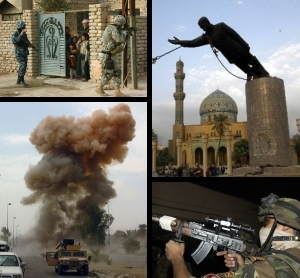
Clockwise, starting at top left: a joint patrol in Samarra; the toppling of the Saddam Hussein statue in Firdos Square; an Iraqi Army soldier readies his rifle during an assault; a roadside bomb detonates in South Baghdad. (Wikipedia)

America invades Iraq: Lawrence Wilkerson, in 2002 a member of the State Department's Policy Planning Staff and later chief of staff for Secretary of State Colin Powell recalled in an interview that, "the Israelis were telling us Iraq is not the enemy --Iran is the enemy. If you are going to destabilize the balance of power, do it against the main enemy." Wilkerson recalled that the message “was conveyed to the administration by a wide range of Israeli sources, including political figures, intelligence and private citizens.” Nor was Israel the only concerned bystander.Turkey’s prime ministerBulent Ecevit, at a time when that country was still a strong ally of the United States and Israel and still under secular rule delivered the same message, as did the Saudis, Lebanon and Egypt.

Hosni Mubarak prophetically “told the American government that if you strike at the Iraqi people... we fear a state of disorder and chaos may prevail in the region." 

As Air Force 2 approached Riyadh on the first leg of a mission to convince the Saudis and Gulf Emirates that America invading Iraq was in their interest, Dick Cheney was informed that Crown Prince Abdullah had just told ABC News, ''I do not believe it is in the United States' interests, or the interest of the region, or the world's interest, to do so… And I don't believe it will achieve the desired result.” But neither the advice of the Saudis, the Israelis and the Turks individually or collectively could deter Bush once he made up his mind.

From the beginning the logic of those warnings by America’s allies in the region should also have been obvious to America’s policy-makers. For how could anybody with any background in the region have not foreseen the pivotal role of Iraq as deterrent to Iran? But the administration was bent on following its own inner voice. Emblematic of administration ignorance, Vice President Cheney told Meet the Press that he and Bush fully expected the American invaders to “be greeted as liberators.”

It seems like only yesterday we were marching into Baghdad, waiting to be greeted with shouts of gratitude and appreciation for saving you from the evil dictator who ruled your totalitarian state with an iron fist. Well, the surge is over and we're gonna roll pretty soon, so I just wanted to mention that it's not too late to greet us as liberators if you get the chance.” GEN. RAY ODIERNO (APT SPOOF IN ONION)

America’s informal alliance with Iran: The Iranians had fought a decade-long war with Iraq and suffered a million casualties. The Islamic Republic was not anxious to try again. They needed a proxy to topple Sadam. America’s first Gulf war stopped at the gates of Baghdad because Bush, Sr. understood Sadam’s role as deterrent. “Iran knew it could not invade Iraq and win by itself.” Iran would have to encourage the Americans to do the job for them.

Influential people in the White House, the Pentagon and Congress saw [Ahmed Chalabi] as an Iraqi George Washington.” The MIT-educated, secular Shiite Muslim, “was the Pentagon's and Vice President Dick Cheney's candidate to lead Iraq after the U.S.-led invasion toppled Saddam Hussein in 2003.” In fact Chalabi, close confidant and major source of intelligence regarding those phantom Iraqi WMD (weapons of mass destruction and rationale to invade), was an Iranian spy who both kept Teheran informed of US planning, and provided Bush what it wanted to hear in support of its intentions: The CIA blames him for some of the bad intelligence about weapons of mass destruction in Iraq.” And, intelligence officials now believe that Iran used the hawks in the Pentagon and the White House to get rid of a hostile neighbor, and pave the way for a Shia-ruled Iraq.”

Rather than the welcome as liberators of the oppressed Shia majority of Iraq the “liberators” were met by a well organized community bent on fighting the infidels. While Ahmadinejad had been baiting the American invasion the Iranian Revolutionary Guard had been organizing and training their Shia co-religionists to fight the invasion. Iran funded, provided weapons and training and, as the insurrection progressed, even officers to lead the militias. It turned out that defeating the Iraqi army and deposing Sadam was the easy part.

Iran had deftly manipulated the superpower, and would deftly continue to do so with great profit. With the US military bogged down in Iraq the administration had little appetite for yet another Muslim adventure. Although they could never acknowledge it, Bush was now dependent on Iran as a moderating force needed to keep American casualties low. When in 2007 Bush introduced his “successful” Surge, its success was dependent on Iranian cooperation. Ahmadinejad ordered the Shia Mehdi Army, highly successful in fighting the Americans, to withdraw from the streets of Baghdad.
The US plans to establish a diplomatic presence in Tehran for the first time in 30 years as part of a remarkable turnaround in policy by President George Bush.” Was it mere coincidence that the Mehdi Army abandoned the streets to the US, and that Bush provided Ahmadinejad that State Department Interest Section in downtown Teheran, reversing a thirty year US policy of diplomatically isolating the Islamic Republic? But if Bush bought Iranian assistance with that Interest Section it was unnecessary. Iran would have gladly provided Bush any assistance desired, no strings attached, to encourage the Americans to leave. That had been Iranian policy from the start.    
The Iranian Bomb: On its surface, based on the statements of Bush and Cheney, the US was committed to use force to stop Iran’s nuclear bomb project. But if that were really policy, why appoint a defense secretary who opposed that policy from the start; why appoint a chairman of the Joint Chiefs of Staff who saw eye-to-eye with the defense secretary? In fact American policy regarding the Iranian bomb had been bluster and inaction long before the 2007 National Intelligence Estimate on Iran provided cover by concluding, “with high confidence that in fall 2003, Tehran halted its nuclear weapons program.”

But Gates and Mullen needed no such fig leaf; they had long been on record opposing war with Iran. “In 2007, [Secretary of Defense Gates] told a private meeting of Congressmen that bombing Iran would "create generations of jihadists, and our grandchildren will be battling our enemies here in America… They will start a nuclear arms race in the Middle East and they will be less secure at the end than they are now." And chairman Mullen: “Iran getting a nuclear weapon would be incredibly destabilizing. Attacking them would also create the same kind of outcome.” What do such statements mean in context of the president who hired them? What does it say about the intentions of Bush’s successor: President Obama asked both to remain?

…Mr. Panetta is the third top American official to raise an alarm about Iranian influence in Iraq in recent days. The American ambassador to Iraq, James F. Jeffrey, said last week that the United States had “forensic” evidence that weapons and weapons parts from Iran were being used by Shiite militias against American troops. His remarks were echoed two days later in Washington by Adm. Mike Mullen, the chairman of the Joint Chiefs of Staff… Iran’s motive, American officials say, is to claim credit for driving American forces out of Iraq at a time when those forces are more than halfway out the door… In April, Robert M. Gates, Mr. Panetta’s predecessor as defense secretary, all but begged the Iraqis to ask for troops to stay… On Sunday, Mr. Panetta echoed Mr. Gates.